
How I turn bland product documentation into content that actually wins technical buyers
I don’t often talk about where content marketers get it wrong.
But one of the most common complaints I hear from the C-suite is when their detailed, complicated and technical products and APIs have been stripped back too much, dumbed down to the real basics.*
Whether you’re trying to make complex topics accessible or add life to something bland and boring, if you’re trying to target technical decision-makers, then you’re probably over-simplifying.
*Unfortunately, that goes for even the most beautifully written piece, because the positioning is just plain wrong.
Definition and explainer-based content is useful in the right settings (like for getting citations in AEO or improving search authority on a completely new topic). But one area that it won’t work is when you’re targeting a highly educated buyer who is already familiar with the landscape.
And by the way, I’m speaking from experience. I made these mistakes first-hand during my first weeks for a new client a few years ago. Because I had limited knowledge on the topics I was writing, I was breaking them down to my own level of understanding. But this was far too simplified for the subject matter experts who would be reading the content and making their buying decisions around it. We quickly realised that ‘translating technical jargon into simple language’ (my actual USP for a few years) wasn’t the flex I thought it was.
So, here’s my formula for winning over technical buyers in your content:
Include specific customer and industry knowledge
Focus on pain points
Learn how to talk about your product
Create a reason to act
When stripping it back doesn’t work
When your reduce product that rely on technical APIs and proprietary AI algorithms down to it’s basic ‘what is X’, you create three issues.
The first: your target audience doesn’t recognise themselves in the content. They don’t relate. They click off.
The second: it has no point of view. You’re not saying anything new or original, giving the reader no reason to continue.
The third: You lose credibility. Without going into the details about your experiences, your customers and your trials and tribulations, your content sounds like it could be regurgitated from anywhere else on the web. And that means you lose share of mind when the buyer is ready to make their decision.
How I translate highly-technical products into content that converts
My formula has four key areas, and I must stress that each of these factors is just as important as the others. I’ve tested this framework A LOT over the last two years or so, ever since I started tracking the leads that came from my content work.
My biggest tip: have your own internal technical leader read through the piece before it gets published to check that it’s positioned to the right level of understanding.
Include customer and industry knowledge
The foundation for any good piece of content is what I call: making it feel like an inside job.
What I mean by that, is for a reader to feel like
a) you know them, and
b) you know what you’re talking about.
I dread to think about the number of pieces I wrote about random 401k rules or Brazilian regulations at the beginning of my career. All I had to go on was Google research and would fall into the trap of overexplaining every little detail, without even realising. It meant that anyone with even a smidge more of experience than me would easily be able to tell that I didn’t know what the hell I was talking about.
To build customer knowledge, and create customer-led content, you need to drill down your ICP and know the language your customer(s) uses. In case you don’t already have this data, the easiest way to get it is to ask AI to comb through your sales calls or customer feedback forms and ask it to check things like:
How they talk about their problems and which pain points they identify
How they talk about your product or category of product
Patterns in benefits / positive reviews
Patterns in objections
Places on your website where you refer to any of the above in a significantly different way to customers, where they could find your current language confusing or misleading
On the opposite end of the spectrum, many experts don’t realise the extent of their knowledge. Advanced concepts and interesting opinions are both devalued, because the expert often sits in an echo chamber of other highly-experienced colleagues. They think everybody knows what they know - known as an expert blind spot.
The best way I’ve found to build industry knowledge is for your writer to borrow it from a subject matter expert, often through an interview. It’s an efficient way to build a foundation for a new topic, but it also allows the writer to form a point of view - important for engaging the reader (whether they agree or not).
I tend to prep around 8-12 questions in advance of these interviews, but really let the SME guide me on what we should be saying about the topic, and why.
2. Focus on pain points
Most content marketers look at keywords and trending topics to inform their content strategy. But that workflow often falls flat, because it offers the reader nothing to gain. Instead, you want to make your target reader think: this was written just for me.
Dive back into all the research you did earlier, plus competitor websites, review sites and social media threads about your product.
This time, here are the things to ask AI to look for:
Frequently Asked Questions - anything that is not currently obvious when prospects head to your website, or from an industry-wide Google search (use people also asked if you don’t have any customer data on this)
The results described in case studies for you or your competitors - indicating how users will benefit once their pain point is solved
Expressions of frustration in reviews and sales calls - maybe the areas that still haven’t been solved yet and reasons for migration between platforms
How your prospects talk about success: do they care about saving operational spend, scaling processes or removing busywork?
Once I know my ICP’s pain points, I will map specific technical benefits, workflows or features to them, building content pieces at the target reader’s level of understanding.
But it’s not just about providing a solution to the problem, readers usually want to know how you got there, what their other options are, and how to make their decision. This leads us into the next step: talking about your product.
3. Practice talking about your product
So many brands in fintech and regtech are hesitant of talking too much about their product. Whether it’s being worried to put too much out there in case competitors steal proprietary data, or being apprehensive of regulatory enforcement action, talking about your product is the one big thing that I always encourage the C-suite to concede on.
When you talk about your product well, it has three huge benefits:
enabling you to own the way your brand and products are spoken about
informing and correcting how you’ll be described by AEO
promoting transparency and trust, enabling you to build credibility with your target audience
So, how do I do it for technical readers? And specifically with the goal of getting them moving through the funnel? Usually, I pick a few from the following list:
Skip the education piece: your buyer is highly familiar with the market - dive straight into the parts that matter to them, like comparisons and use cases, instead of introductory explainers or scene setting
Translate technical features into real outcomes: the pain points or transformations that matter most to your technical ICP, in their own language
Talk about value: share the most relevant results - remembering that technical decision-makers most often care about factors like set up time, integration methods, support SLAs and disaster plans rather than business cases metrics like money and time
Use real life examples: share genuine customer problems from fellow technical buyers and give context on how they were solved
Include video demos or image screenshots: reveal what a technical user would see and do with your product to achieve the results
Use deep links to let the reader navigate to what matters most to them: layer your information and allow technical readers to get more detail when they need it
Create a reason to act
Finally, the last piece of the puzzle in translating technical APIs into content that converts is about the conversion itself. After all, the reader must take the next step.
There’s no single way to do this, but the general gist is to convey the value exchange. You’re effectively trying to answer one of the following two questions up front:
‘What have you already given me that’s proof you’re worth my time?’ OR
‘What will I get back if I give you permission to contact me?’
There are a number of different ways that I encourage action on the readers’ part:
ROI calculations: show the monetary value of an investment amount
Case study or testimonial inclusions: build credibility by sharing results with similar companies or buyer roles
FOMO: focus on the cost of inaction or opportunity loss
Urgency: promote limited availability or deadlines (specifically useful when regulatory deadlines are coming)
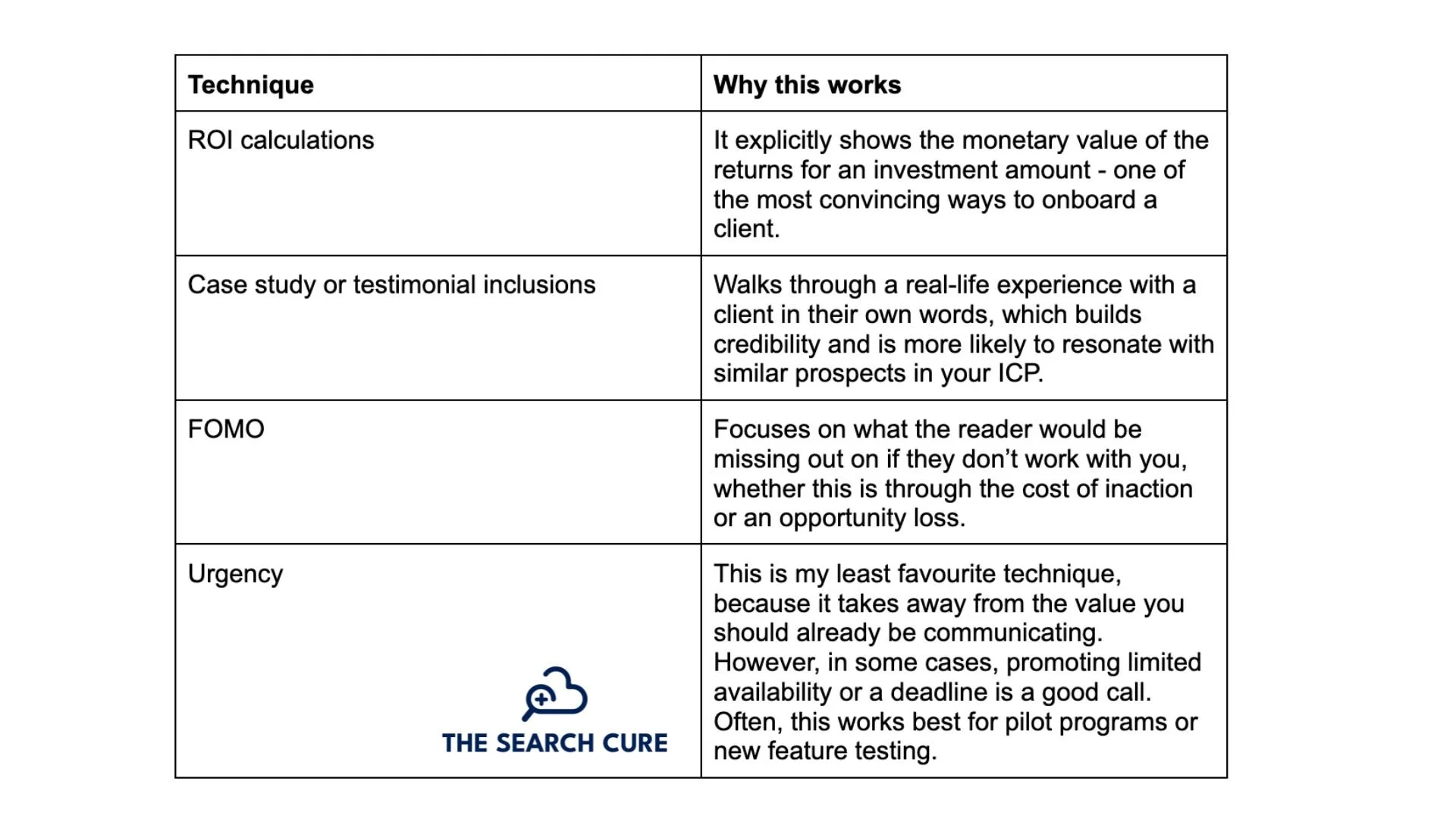
Table showing some of my favourite techniques for generating action - whether it’s booking a call or a demo for a technical buyer.
Win over decision-makers by getting your highly technical content right
I started off this piece by talking about where content marketers tend to get it wrong. But what about when you get technical content right? For me, this has resulted in a few wins for my clients:
Learning how to talk about problems in the same way their prospects do, thus optimising the sales cycle
Building authority with the people that matter - the technical decision-makers that often have the most sway over vendor decisions within the buying committee
Owning the narrative on product performance, feeding the information that prospects actually need to feel confident in their market evaluations and reaching a decision quicker
If you’re ready to head off into the big bad content world and make use of this framework, I’d love to hear how you get on. Please let me know what’s working for you, specifically within the more technical side of your product marketing.
And similarly, if you need help from someone who’s done this before and knows what works, feel free to message me on LinkedIn or fill in the form below.